
WELCOME BONUS 300%
UP TO €2000 + 100
FREE SPINS
UP TO €2000 + 100
FREE SPINS
Home → Blackjack
Blackjack at Big Lucky Casino: Variants, Rules and Payouts
Unlimited seats via a split dealer hand
Infinite Blackjack by Evolution features a table design that accommodates an unlimited number of players simultaneously. This structural advantage removes physical seating constraints, allowing broad access to the digital felt without capacity limits.
The game operates with a theoretical return to player (RTP) of 99.47%, which is slightly lower than the 99.56% RTP of Lightning Blackjack. The presence of four side bets adds volatility but does not alter the base game's fundamental mathematical edge for the house.
Players can place bets ranging from 1 EUR to 5,000 EUR, providing flexibility for both casual and high-stakes participants. Table games contribute only 10% toward bonus wagering requirements, meaning a 100 EUR bet counts as just 10 EUR toward clearance.
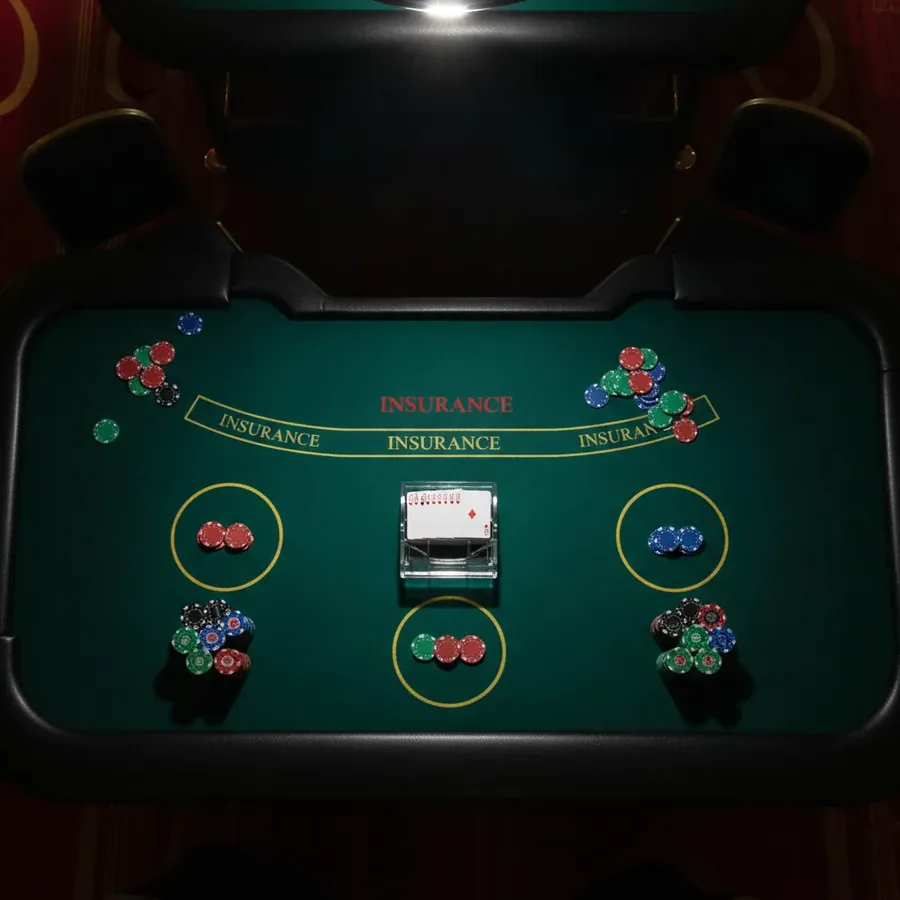
Register Late Surrender correctly in three steps
Late Surrender allows a player to forfeit their hand after the dealer checks for blackjack, recovering exactly 50% of the initial stake. This rule modifier improves the overall RTP by approximately 0.08 percentage points compared to a standard no-surrender game.
Early Surrender is significantly more valuable, potentially reducing the house edge by up to 0.6 percentage points, but it is extremely rare in modern online environments. Players must wait until the dealer's hole card is verified before executing this move to avoid invalidating the surrender action.
Standard deviation for liberal rule sets like Vegas Strip stands at 1.15, indicating moderate variance during play. Since table games contribute only 10% to turnover, utilizing surrender rules helps preserve bankroll while meeting the 300% welcome bonus conditions slowly.
RNG draws cards from virtual eight-deck shoe
Blackjack 6 Decks uses six decks with a dealer standing on soft 17, yielding a house edge of 0.46% when basic strategy is applied perfectly. This configuration offers an RTP of 99.54%, making it one of the more favorable RNG variants available on the platform.
Using eight decks instead of six increases the house edge by approximately 0.02 percentage points due to reduced penetration efficiency. The Insurance side bet, available when the dealer shows an Ace, carries a much higher house edge of 7.47% and should be avoided.
Resplitting Aces improves the RTP by 0.08 percentage points, while doubling after split adds another 0.14 percentage points to the player's favor. These specific rule interactions are critical for minimizing the house advantage in multi-deck scenarios.
Card Counting at Shuffle Master Table: why it fails
Continuous shuffling machines or frequent reshuffling protocols render traditional card counting strategies mathematically ineffective over time. Without a persistent deck composition, the true count never reaches the +3 threshold required to make insurance bets profitable or to gain a player edge.
Lightning Blackjack introduces random multipliers up to 25x, which fundamentally alters the payout structure independent of card distribution. These electronic enhancements prevent any deterministic advantage based on historical card removal patterns from emerging.
Quantum Blackjack Plus Live applies multipliers up to 1,000x to three-card combinations, further decoupling outcomes from simple high-low counting systems. The RTP remains stable at 99.57% under optimal strategy, but this figure assumes fixed probabilities rather than count-dependent shifts.
Even Money only possible with Dealer Ace
Insurance pays 2:1 if the dealer's upcard is an Ace, offering a hedge against a potential dealer blackjack. However, the house edge on this side bet is 7.47%, making it statistically unfavorable for players not tracking the true count accurately.
For single-deck games, the insurance house edge drops to approximately 5.88%, yet it remains negative expectation for most strategic profiles. The decision to accept even money or decline insurance is strictly governed by the dealer's visible ace and the remaining deck composition.
Basic strategy dictates always rejecting insurance unless the true count is greater than or equal to +3 in counting scenarios. Given that table games contribute only 10% to the bonus turnover, risking capital on high-edge side bets delays the release of the 2,000 EUR maximum bonus.
Blackjack variants at a glance
| Variant | Payout | House edge | Rule | Bet range |
|---|---|---|---|---|
| Blackjack Liberal Vegas Strip (liberale Regeln, 3:2) | 99.72% | 0.28% | Günstigste Regelkombination: S17 + DAS + Resplit + Late Surrender. Standardabweichung 1,15 | Blackjack 3:2, Gewinn 1:1 |
| Blackjack Split / Double / H17 – Regel-Effekte | n.a. (Regel-Modifikatoren) | H17 +0.22 Prozentpunkte; RSA −0.08 Prozentpunkte; DAS −0.14 Prozentpunkte | Dealer Hits Soft 17 verschlechtert RTP um 0.22 Prozentpunkte; Resplit Aces verbessert um 0.08 Prozentpunkte; Double After Split verbessert um ca. 0.14 Prozentpunkte; 6 Decks statt 8 – ca. 0.02 Prozentpunkte. | Double – Einsatz ×2 mit einer Karte; Split – bis 4 Hände; Ass-Split meist mit einer Karte. |
| Blackjack Ein Deck, klassische Regeln, 3:2 | 99.85% | 0.15% | Weniger Decks = niedrigerer Vorteil; ein Deck gibt ca. −0.48 Prozentpunkte gegenüber 8 Decks. Oft durch 6:5 Auszahlung kompensiert. | Blackjack 3:2, Gewinn 1:1 |
| Blackjack Auszahlung 6:5 statt 3:2 (6 Decks) | 98.15% | 1.85% | Ersatz von 3:2 durch 6:5 fügt exakt +1.39 Prozentpunkte zum Vorteil des Casinos hinzu – stärker als jede andere Regeländerung. Bei $10 Einsatz zahlt Blackjack $12 statt $15. | Blackjack 6:5, Gewinn 1:1 |
| Blackjack 6 Decks, S17, DAS, DOA, Auszahlung 3:2, Basisstrategie | 99.54% | 0.46% | Dealer steht auf Soft 17; Verdopplung auf jeder Zweierkarte; Verdopplung nach Split erlaubt; keine Aufgabe. Basisstrategie ist für diesen Wert zwingend | Blackjack 3:2, normaler Gewinn 1:1, Insurance 2:1 |
| Blackjack Surrender (Late Surrender) – Regel-Effekt | n.a. (Regel-Modifikator) | −0.08 Prozentpunkte | Spieler gibt Hand nach Dealer-Blackjack-Prüfung auf, verliert die Hälfte des Einsatzes. Verbessert RTP um ca. 0.08 Prozentpunkte. Early Surrender ist wesentlich wertvoller (bis −0.6 Prozentpunkte), aber extrem selten. | Rückzahlung 50% des Einsatzes |
Seat change at the Live Table in 20 seconds
The Quantum Blackjack Plus Live table by Playtech allows seat changes within 20 seconds, accommodating unlimited players at once. This rapid turnover is critical for high-stakes sessions where a €5,000 maximum bet requires frequent position adjustments to manage bankroll variance effectively. Players can seamlessly switch spots without interrupting the continuous flow of the Quantum Multipliers up to 1,000x on three-card combinations. This feature ensures that strategic positioning remains accessible regardless of the dynamic betting limits or the intensity of the live dealer's pace.
Continuous Shuffling Machine shuffles after each round
The Lightning Blackjack variant by Evolution utilizes a Continuous Shuffling Machine (CSM) that reshuffles cards immediately after every single completed round. This mechanical process eliminates any possibility of card counting strategies from gaining an advantage over the fixed 99.56% Return to Player rate. The constant renewal of the deck prevents players from tracking the composition of remaining cards during the 25x multiplier events. Consequently, the house edge remains mathematically stable across all betting intervals, ensuring that no temporal strategy can alter the long-term expected value.
What Percentage Does Blackjack Count Towards Bonus?
Blackjack games contribute exactly 10 percent toward the wagering requirements of the 300% welcome bonus up to €2,000 plus 100 free spins offered by Big Lucky Casino. In contrast, slot machines contribute 100 percent, making them significantly more efficient for clearing the required turnover volume before withdrawal eligibility. For instance, a €100 bet on blackjack only reduces the playthrough obligation by €10, whereas the same stake on slots clears the full amount. This disparity forces players to allocate their bankroll strategically between high-contribution slots and low-contribution table games to meet the terms efficiently.
Six Decks to Eight Decks in the Shoe
The Blackjack Ein Deck variant operates with a single deck and classic rules, delivering an RTP of 99.85% and a house edge of just 0.15%. This configuration offers approximately 0.48 percentage points lower advantage compared to eight-deck games, though it often compensates with less favorable 6:5 payouts.
In contrast, the standard six-deck game uses S17, DAS, and DOA rules to achieve an RTP of 99.54% with a 0.46% house edge. The Liberal Vegas Strip version improves this further to an RTP of 99.72% by combining S17, DAS, Resplit, and Late Surrender, resulting in a significantly lower house advantage of only 0.28%.
Switching from a 3:2 payout to a 6:5 payout on six decks drastically increases the house edge to 1.85%, reducing the RTP to 98.15%. For a 10 EUR bet, this rule change pays 12 EUR instead of the standard 15 EUR, directly impacting the bonus turnover contribution where table games count for only 10%.
Stand-on-17 Rule and Its Meaning for Players
The Stand-on-17 (S17) rule requires the dealer to stand on all hands totaling 17, including soft 17, which is a player-favorable condition. When the dealer hits soft 17 (H17), the house edge increases by exactly 0.22 percentage points, negatively affecting the overall return to player across various blackjack variants.
Comparing the base strategies reveals that S17 combined with Double After Split (DAS) reduces the house edge by 0.14 percentage points relative to H17 scenarios. The Liberal Vegas Strip variant utilizes S17 alongside Resplit Aces and Late Surrender to secure a low 0.28% house edge, demonstrating how standing rules critically define game value.
Players must adhere strictly to basic strategy in these environments, as deviations can erase the mathematical advantage provided by S17 rules. The Insurance side bet remains highly unfavorable regardless of the dealer's standing rule, carrying a massive 7.47% house edge and an RTP of only 92.53% for six to eight decks.
Live Table vs RNG Table: Speed and Limits
Lightning Blackjack by Evolution allows bets between 1 and 2,500 EUR with unlimited players, offering multipliers up to 25x on winning hands. This live format maintains an RTP of 99.56%, providing a high-limit environment distinct from standard RNG tables while contributing minimally to bonus wagering requirements.
Quantum Blackjack Plus Live from Playtech supports stakes from 1 to 5,000 EUR and features Quantum Multipliers up to 1,000x on three-card combinations totaling 21. With an RTP of 99.57% under optimal strategy, this high-stakes live option differs significantly from the Infinite Blackjack table which caps at 5,000 EUR but offers four side bets.
Infinite Blackjack by Evolution accommodates unlimited seats with bets ranging from 1 to 5,000 EUR, focusing on standard gameplay with side bets like Any Pair and Hot 3. Its RTP stands at 99.47%, slightly lower than the other two live variants, yet all live tables contribute only 10% toward the required turnover for the welcome bonus.
Double Down vs Simple Hit on 11
Double Down allows players to double their initial stake with exactly one additional card, a move statistically mandatory on hard 11 against most dealer up-cards. This action is permitted after splitting in variants allowing DAS, which improves the RTP by approximately 0.14 percentage points compared to games prohibiting this flexibility.
When comparing a simple hit on 11 to doubling down, the latter maximizes expected value due to the high probability of drawing a ten-value card. In the Six Deck S17 variant with DAS and DOA, adhering to this basic strategy is essential to maintain the 99.54% RTP and keep the house edge at its lowest 0.46% level.
Resplitting Aces provides a separate strategic consideration, improving RTP by 0.08 percentage points when allowed, though typically restricted to receiving only one card per ace. Combining DAS with Resplit Aces and Late Surrender creates the Liberal Vegas Strip conditions, achieving the best possible RTP of 99.72% among standard configurations.
Soft 17: Dealer Hits or Stands
When the dealer hits soft 17 (H17), the house edge increases by 0.22 percentage points compared to dealers standing on all 17s. This rule change negatively impacts the RTP across all deck counts, making games with H17 less profitable for players attempting to meet the 10% contribution requirement for the Big Lucky Casino welcome bonus.
The Liberal Vegas Strip variant mandates the dealer stands on soft 17 (S17), which is a key factor in achieving its superior 99.72% RTP. This favorable rule, combined with DAS and Resplit Aces, reduces the house edge to 0.28%, illustrating how specific soft 17 protocols directly determine the long-term return for the player.
Insurance bets become marginally less disastrous with fewer decks, dropping from a 7.47% house edge in six to eight decks to roughly 5.88% in a single-deck game. However, basic strategy still dictates always rejecting insurance unless counting cards with a true count of +3 or higher, preserving the integrity of the primary hand's expected value.
Contact
Live - online chat
Banking









Providers












Big Lucky Casino 2026